Scientific foundation
A procedure.
Scientifically grounded.
Elicitation is measurement technology for experience. The method adapts proven procedures from epistemology, knowledge management and expertise research — and makes them workable for people with full calendars.

“We can know more than we can tell.”
Tacit knowledge — Polanyi
The core of entrepreneurial excellence is implicit: it can be shown, but hardly written down. This is exactly why classic knowledge bases and succession handbooks fail. mindmodels starts at the source — episodic experience itself.
SECI spiral — Nonaka & Takeuchi
Since “The Knowledge-Creating Company” (1995), the externalisation of implicit knowledge has been regarded as the most valuable and most difficult step of knowledge creation. The daily serial dialogue is an externalisation procedure in series — daily, cumulative, individual.
Cognitive task analysis — Ericsson, Klein
The method adapts proven elicitation techniques from expertise research — Critical Decision Method, laddering, contrast and boundary probes (naturalistic decision making) — to a format that fits the life of a busy decision-maker.
From knowledge bottleneck to Mind Model
Knowledge elicitation was the historic bottleneck of expert systems — and is the bottleneck of personalised AI today: large models can do many things, but not your judgement. Curated, structured experience data of individual top decision-makers is the scarcest asset of the next model generation. Whoever owns it, owns an asset.
V·04Literature — the foundations, to read up on
Polanyi, M. (1966): The Tacit Dimension.
Nonaka, I. & Takeuchi, H. (1995): The Knowledge-Creating Company.
Klein, G., Calderwood, R. & Macgregor, D. (1989): Critical Decision Method for Eliciting Knowledge. IEEE Transactions on Systems, Man, and Cybernetics 19(3).
Hoffman, R., Shadbolt, N., Burton, A. M. & Klein, G. (1995): Eliciting Knowledge from Experts. Organizational Behavior and Human Decision Processes 62(2).
Ericsson, K. A. et al. (eds., 2018): The Cambridge Handbook of Expertise and Expert Performance, 2nd ed.
Kahneman, D. & Klein, G. (2009): Conditions for Intuitive Expertise — A Failure to Disagree. American Psychologist 64(6).
Shiffman, S., Stone, A. & Hufford, M. (2008): Ecological Momentary Assessment. Annual Review of Clinical Psychology 4.
Knowledge dies twice.
Both deaths have become avoidable.
The first death is biological: with every person, judgement disappears that no one wrote down — because it cannot be written down (Polanyi). The second death is institutional: organisations lose knowledge they believed they possessed. NASA never lost the Saturn V documentation — and still could not build the rocket again, because the people who could read between the lines were gone.
Both are hitting ageing economies simultaneously: in Germany alone, the baby-boomer cohorts — close to 30 percent of today's workforce — reach retirement age by the mid-2030s (Federal Statistical Office). Research on knowledge attrition has described for two decades what happens next: decision quality drops, errors repeat, handovers fail (DeLong, Lost Knowledge, Oxford 2004). Large enterprises put the productivity losses from inefficient knowledge transfer alone at tens of millions per year (Panopto/YouGov 2018).
And it is a matter of self-respect. Developmental psychology calls the core task of mature life generativity: the need for one's work to carry beyond one's presence (Erikson). Letting a lifetime of decisions simply evaporate — now that it has become preservable for the first time — is not modesty. It is an omitted legacy: towards yourself, your family, and your life's work.
Sources: Polanyi (1966), The Tacit Dimension · DeLong (2004), Lost Knowledge: Confronting the Threat of an Aging Workforce, Oxford Univ. Press · Panopto Workplace Knowledge & Productivity Report (2018, with YouGov) · Federal Statistical Office of Germany, labour force projection · Erikson (1950), Childhood and Society.
An ark for judgement.
mindmodels does not come from nowhere. It is the consistent application of what the gannaca think tank has been documenting since 1996: see technological and societal ruptures early, translate them into decisions, keep responsibility — the human decides, the machine assists (Peterka, Symphonie der Systeme, 2025).
The macro fact behind it: the large language models have largely read the open web empty — researchers expect the stock of high-quality, publicly available text data to be exhausted within this decade (Villalobos et al., Epoch AI). What counts afterwards is what never stood on the web: curated, evidenced, episodic decision knowledge of individual top minds. Whoever owns it, owns the scarcest raw material of the next model generation. Whoever gives it away has already given it to the platforms.
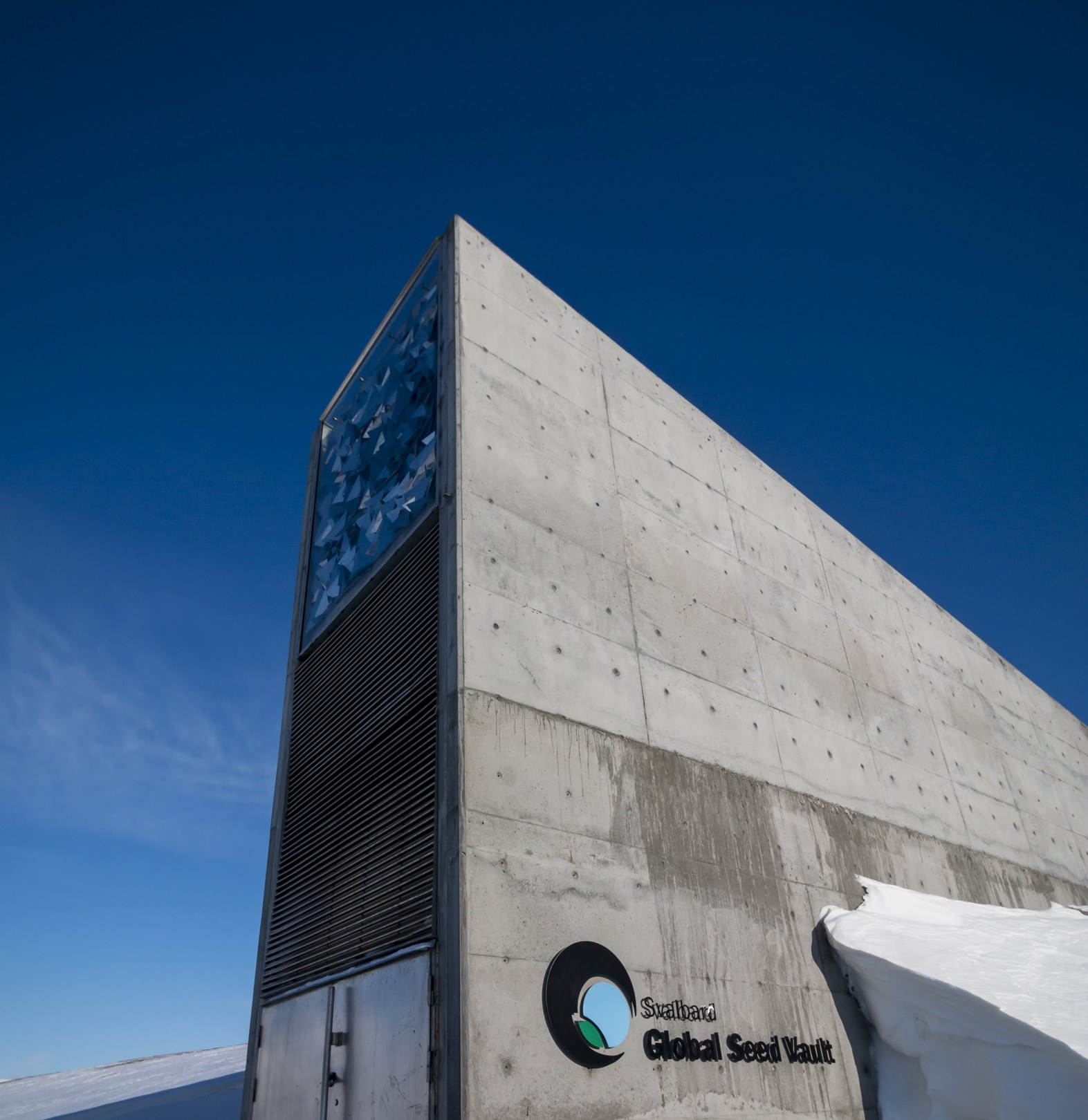
On Svalbard, humanity stores seeds — not because tomorrow's harvest will fail, but because no one knows which variety will be vital the day after. The Ark did not take everything; it took what could germinate. mindmodels is that vault for judgement: not all knowledge, but the part that can sprout again — yours.
Svalbard Global Seed Vault, since 2008 (photo: Tiq, Wikimedia Commons, CC BY-SA 4.0, cropped) · Genesis 6–9 · mindmodels, since 2026Two ways in — one costs €490, the other a conversation.
The Probe is the small proof in seven days, fully credited towards Tier I. The mandate is the whole way: 30 days, one model, your property. For universities and organisations there is the Cohort Programme.