01 · Starting point
Implicit knowledge
Decades of judgement — bound to your person, documented nowhere, accessible to no one. Yet.
Decades · unretrievedProcedure · Tier I–III
Four decades of decisions have produced something in you that appears in no org chart, no handbook and no succession plan: judgement. We ask the right questions, long enough, in the right order — and build a model of your thinking from your answers.
One single, precise question per day — where you already think: on your phone. Each question builds adaptively on your previous answers and drills where your experience is densest: critical decisions, misjudgements, grey areas, gut calls that proved right.
Episodes become patterns. Your answers are methodically condensed into heuristics, decision rules, priority orders and edge cases — the actual scaffolding of your judgement, which you yourself would never have written down this way.
The structured knowledge is turned into a machine-usable Mind Model: queryable in dialogue, integrable into your organisation, trainable on new situations. Your thinking — available even when you are not in the room.
Decades of judgement — bound to your person, documented nowhere, accessible to no one. Yet.
Decades · unretrieved
One precise question per day on your phone — Critical Decision Method, laddering, boundary probes. Episode by episode.
30 days · 1 question / day
Episodes become patterns: heuristics, decision rules, edge cases — the scaffolding of your judgement.
Patterns, not anecdotes
Your thinking as a machine-usable model: queryable in dialogue, integrable into your organisation — and in your possession.
Queryable · transferable · yoursFig. 1 — Externalisation of implicit knowledge with the mindmodels method. The daily short dialogue (Critical Decision Method, contrast & boundary probes, laddering) retrieves episodic experience; continuous condensation turns it into three modellable layers from which the personal Mind Model emerges. Method: Christopher Peterka, gannaca.
The serial dialogue rotates six elicitation techniques, each retrieving a different layer of decision knowledge:
The order is no accident but a pre-defined, auditable protocol — questioning technique and time of day rotate almost orthogonally, so that patterns can be attributed cleanly.
The method works with elements of experience sampling (ecological momentary assessment, Shiffman et al. 2008): questions reach you at systematically varied times of day. Response latency, modality and length are read — with your knowledge and consent — as context signals.
This yields not only a picture of what you judge, but of when your judgement works analytically and when associatively. For the later model, that is gold: it also learns the operating conditions of your thinking.
What does judgement look like when you make it visible? Four models, four entirely different architectures — because a dealmaker thinks differently from a negotiator, a portfolio strategist differently from a crisis decision-maker. The sculptures show what the method retrieves: the structure, density and pathways of a thinking that is unique in each case.

A dense web of relationships, few but highly resilient nodes: opportunities are recognised through people, not lists.

Layered scenarios, each level a trajectory: positions, fallback positions, exit points — transparent down to the last resort.
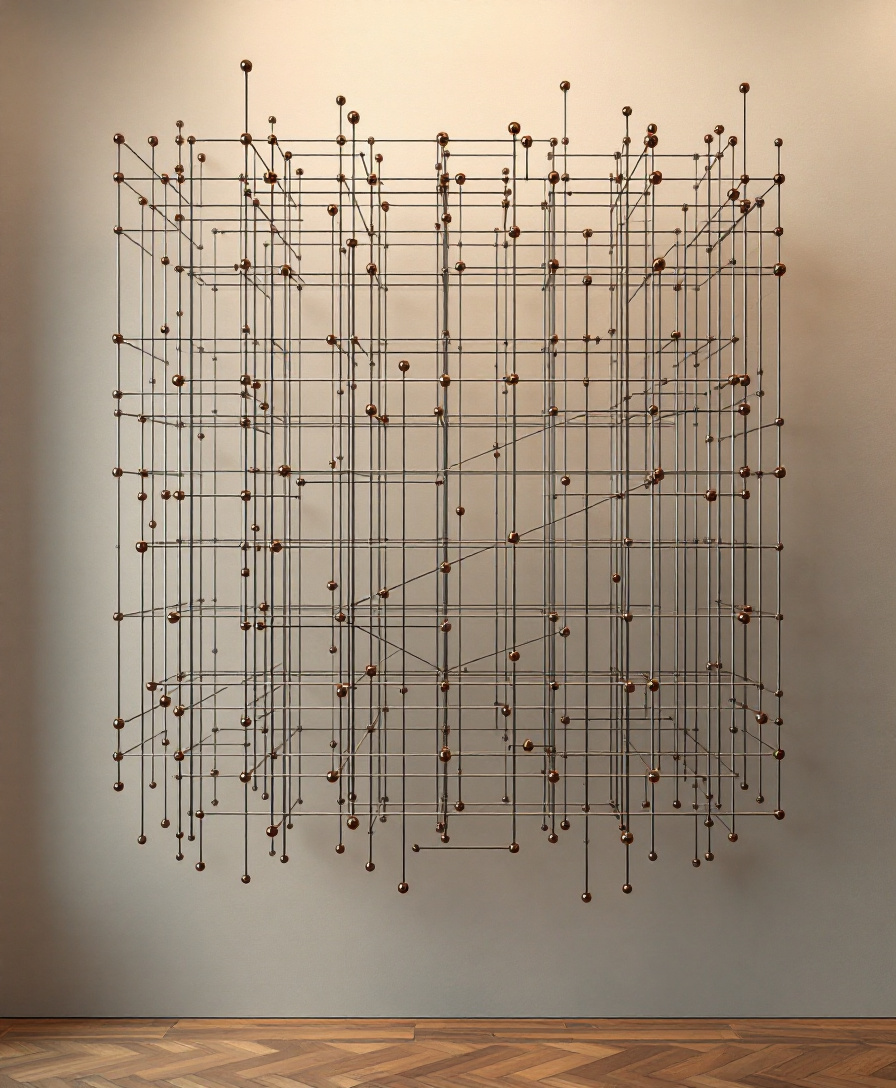
A grid with weighted intersections: capital, time and attention flow to where nodes condense.

A compressed core — and always three ways out: whoever leads through crises thinks in options first, causes second.
Fig. 2 — Four architectures of judgement. Artistic materialisations of real model types from the mindmodels workshop. Your model will look different — that is the point.
The Probe is the small proof in seven days, fully credited towards Tier I. The mandate is the whole way: 30 days, one model, your property. For universities and organisations there is the Cohort Programme.